PoolSynergy December 2011

How do you recharge your batteries?

Welcome to the 26th edition of PoolSynergy, a collection of some of the best writing the pool world has to offer.  For the December edition of PoolSynergy, it was my privilege to select a topic for discussion, and with the holiday season approaching I knew exactly what I wanted to write about.  It is well known that playing great pool requires a lot of time and dedication.  I absolutely love the game; however, based on my personal experience I know there are times when I overload on pool and need to take a break from the table.

This is especially true during the holiday season.  This is the time of year when we serious pool junkies begin to notice the non-pool playing parts of our lives are jockeying for our attention and we lose mental focus.  There are holiday parties with friends that we are expected to attend, work related gatherings that we need to survive, family reunions we need to endure (and enjoy), holiday shopping to be done, religious celebrations to attend, etc.  With the holiday season approaching, I began to wonder:  (1) what should I do with my time if I take a break from the table, (2) what do other pool players do when they are away from the table, and (3) how do we recharge our emotional and/or physical batteries so that we can come back to the table feeling physically and mentally refreshed and ready to play?  This month, the PoolSynergy writers accepted the arduous task of addressing the topic: How do you recharge your batteries? 

Our first contributor is John Risner.  John is a first time contributor to PoolSynergy and we are very happy to welcome him to the community.  John is a pool player and blogger from Tennessee who has challenged himself to train for and win the Men’s U.S. Amateur Championship Title.  John’s article first provides a humorous yet frighteningly accurate description of how otherwise ordinary human beings get hooked on the game, then he provides some insight into how he handles himself in situations where most players get discouraged and get burned out.  Check out John’s article here.

Next up is Suzanne Smith, a pool player and blogger from Washington.  Suzanne is now a two time contributor to PoolSynergy and we are very happy to have her back.  You may recognize her name…she is the 2011 U.S. Amateur Women’s Champion!!!  This month, Suzanne gives us a look at some of her off season activities, which includes spending time with her family, taking lessons, watching live streaming matches, and planning her pool tournament schedule for the upcoming year.  Check out Suzanne’s article here.

Melinda, aka Trigger, is an avid pool player and award winning blogger who hails from the great state of Texas.  Melinda provides us with some very sound advice: when life throws us curveballs and we get mentally derailed from our game, one method for getting back on track is to set goals and hold ourselves accountable.  You can read Melinda’s article here.

Mike Fieldhammer is a professional pool player and frequent blogger from Minnesota.  This month Mike provides us with some fantastic advice on how to avoid burnout.  Playing pool is Mike’s full time job, so he certainly has a vested interest in making sure he keeps his game sharp.  Whether he’s involved in summertime activities, traveling on the road to big tournaments, or enduring the normal day to day pool grind, Mike has lots of experience and advice on keeping your mental game up and avoiding burnout.  Read Mike’s article here.

John Biddle is a dedicated player from Florida who is also the father of the entire PoolSynergy effort.  John decided to turn this month’s PoolSynergy topic on its head and describe how he uses the game of pool itself as a tool to recharge his batteries so he can deal with life away from the table.  You can read all about John’s thoughts here.

Our 6th PoolSynergy contributor for the month of December is Johnny, a dedicated pool player and blogger from Missouri.  This month, Johnny provides some insight and advice on how to handle ourselves “when the balls seem to blur and the cue seems infinitely curved… ”.  You can check out Johnny’s article here.

And rounding out this month’s collection of articles is my very own contribution.  I have decided to take a few months off from pool.  Unfortunately, I’ve reached that burnout point and now I need some time away from the table to rebalance my life and try to rediscover that inner fire that has fueled the last two years of my pool journey.  Fear not, my pool playing days are not over…I just need a break.  I expect to return to the table in April of 2012.  Until then, you will continue to see periodic updates and musings on my blog.  You can read more about my vacation from pool in my article here.

Taking a Break to Recharge

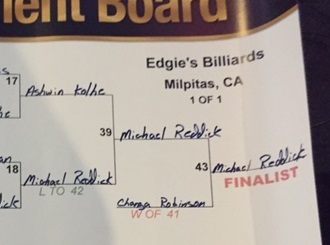
As the host of this month’s pool synergy forum, I wanted to write about a topic that I was familiar with and was also relevant for me.  Over the last two years, I’ve been laser focused on improving my pool game and I believe the prolonged intensity caught up with me this fall about a month before the preliminary round of the 2011 U.S. Amateur Championships.  I was beginning to lose my desire to compete and was mentally exhausted.  In October I somehow managed to pull myself together and was able to win the preliminary round of the U.S. Amateur Championships held in Northern California, but then I immediately reverted back to my mental/emotional slump and couldn’t motivate myself to do any additional training.  After traveling to Florida in November and competing in the finals of the U.S. Amateur Championships, I finally admitted to myself that I was having trouble focusing and I needed to take a break from the game. 

For the entire month of December and probably the first three months of 2012, I’ve decided to take a break from playing pool.  I just need some time to recharge my batteries, reorganize my life, and get refocused on what my goals are in pool and life.  For the time being, here’s my plan for refreshing and recharging myself:

(1) I’m totally revamping my diet.  I’ve gotten rid of all of my junk food, kicked my diet coke addiction, started eating more raw vegetables like carrots, celery, broccoli, etc., drastically reduced my intake of useless starchy carbs and began eating only when hungry, not when the clock tells me it’s time to eat.

(2) I’ve transitioned from being a semi-professional couch potato to adopting a new (and sustainable) exercise program which includes 3 or 4 days of running per week, plus 3 or 4 days of gym work.  The exercise is making a big difference in my energy level and is also a good stress reliever and mental gunk cleanser.

(3) I’m spending a lot of time with friends and family.  I’m flying back east to see my family during the holidays and also plan to take a trip to see some snow in late December.  I think spending a few days at Lake Tahoe or Yosemite will do wonders for me.  My main focus will be resting and relaxation, and maybe I’ll enjoy a little hot cocoa while snuggling up to a cozy fire.  :-)

My intention in making these changes is to be a healthier person both physically and mentally, allow myself to get some rest, rebalance my life, and come back to the pool world next year with a fresh new focus and attitude.  So that’s about it for me.  I plan to periodically provide updates to this blog on my thoughts and musings on pool, so stay tuned.  After all, although I’m taking a short break from the table, I’m still an incorrigible pool player at heart.

U.S. Amateurs Update

U.S. Amateurs Update
 
Slept in late.   :-(      Headed to Strokers in 15 minutes.  Yesterday, I lost my first match 3-7 then won my second match 7-5.  I’ll play again today at noon.  If I continue winning (and that’s a BIG if), I will need to play 6 or 7 straight matches with no breaks to make it to Sunday.  I found out they are live streaming one table on the internet.  Here’s the link from the APA website:
 
 Live streaming from the 2011 U.S. Amateur Championship being held in Tampa, FL (coverage courtesy of Inside Pool magazine and JR Calvert). http://www.usamateurchampionship.com/coverage/2011/


Tampa Bound!

Tonight I’m packing for my trip to Tampa, Florida for the finals of the US Amateur Championships.  Just a short 6.5 hour flight from San Jose to Tampa… I can’t wait!!!!  I’ll be getting to Florida a couple days early to give myself time to adjust to the time zone change.  My plane lands at 10:30pm, so I figure I can check into the hotel and get to Strokers in Palm Harbor by midnight.  I’ll grab a light dinner, visit with some of the locals, then hit a few balls to get accustomed to the equipment.  On Thursday I’ll be at Strokers as soon as they open so I can practice all day and get into stroke while the other competitors are arriving.  Ahhhh, the life of a pool player!

Abandon All Hope

Michael’s pool school is now is session.  9:30 am.  3.8 inch pockets.  Dry erase board.  Video camera.  Working on my errors from the tournament last night.  I finally got the hunger again, and just in time… only two weeks to Florida.  Now it’s time to get serious and take my game to a new level.  Yes, I have a disease… the relentless pursuit of perfection on the felt… and there is no cure. 

A Dream Come True!

My very own table!

Introducing my very own brand new Brunswick Gold Crown III!  Wahooo!   Ok, so the table is not new, but it’s new to me.  Last week Ernesto Dominguez and Oscar Dominguez stopped by my house on their way home from the annual Chuck Markulas Memorial tournament in Sacramento to set up the table in my garage.  Talk about two amazing guys!  It took them almost four hours of hard labor and an unbelievable amount of patience to get the table leveled correctly, but they did a fantastic job.  Below I’ve included some photos from this historic event.  Can you tell I’m excited? 

Is this tight enough?

A few weeks ago I told Ernesto that I wanted tight pockets, but I didn’t really specify exactly what I meant when I said tight.  No worries, he had a solution in mind.  He took the rails from my recently purchased table to his shop in L.A., reworked the wood and cut new cushions, then came back with a product that was much better than I had dared to ask for.  When he first put the rails on, I looked and almost choked!  Take a look at this tight pocket!  He laughed and told me that wasn’t the final resting spot for the rails, and I sighed in relief, wheewww! 

Final pocket - 3.8 inches!

He adjusted the rails to the correct spot, and they were still pretty tight!  How tight are they?   Well, let’s first consider what it means to have normal pockets.  The standard pocket for home recreation is about 5 inches wide, which is good for the casual player.  In most pool halls, the serious players like to play on tables with “tight” pockets.  In general, any table with pockets that are 4.5 inches or less are considered “tight.”  When you get any tighter, let’s say around 4.25 inches, this is considered “super tight.”  The pockets on my table?  3.81 inches!  What is THAT?  Super-duper extra tight?!!  I must admit I was somewhat intimidated at first, but deep down I was excited… excited about the challenge the super duper tight pockets would present, and the possibilities for improvement that they represented.  Now I’ve got to really focus on every single shot.  I’ve got to eliminate that crazy English I tend to over use because tight pockets are very unforgiving, demand extreme accuracy, and also require you to slow the cue ball down (which incidentally is a good thing).  So I’ll need to ditch most of the extreme English and use speed and angles of approach to get proper position.  With a great table at home, I can now hit California Billiards between 5:00pm and 2:00 am, then train at home from 2:00am to 8:00am.  Who needs sleep anyway?  Oh, yeah!  I can feel my game getting better already!  The next step will be to actually clean up the garage so that it’s presentable.  Nah, that can wait!

Ernesto and Oscar Constructing And Finishing My Gold Crown III

Shark Attack!

For this month’s PoolSynergy topic, Gary wanted each of the PoolSynergy writers to share experiences we’ve had with sharking and offer some ideas on how to deal with it.  First things first:  What is sharking?  A quick look at the glossary of cue sports provides the following definitions: 

Shark

  1. Verb: To perform some act or make some utterance with the intent to distract, irritate or intimidate the opponent so that they do not perform well, miss a shot, etc.  Most league and tournament rules forbid blatant sharking, as a form of unsportsmanlike conduct, but it is very common in bar pool.
  2. Noun: Another term for hustler.
  3. Noun: A very good player. This usage is common among non-players who often intend it as a compliment and are not aware of its derogatory senses (above).

Through the years I have had several experiences with players who attempted to shark me.  In almost all cases, the sharking incidences took place in a local bar, not a pool hall.  I’m not exactly sure why this is the case, but in my experience, players who frequent pool halls tend to be more highly skilled and respectful of the game than players who shoot pool in local bars.  What follows is a short list of sharking incidences that I’ve personally experienced. 

  • The Hot Head – I was recently playing a guy in a large tournament who had a bit of a temper problem and a somewhat overinflated opinion of his skills.  After I tied the match at 2-2, my opponent blew his top and yelled in my direction, “I can’t believe you are hanging with me.  I’m a much better player than you.”  Wow.  Really?   
  • The Talker – I was watching a match once, and every time one player left the table, he would sit in his chair and strike up a conversation with folks standing nearby.  It was very disrespectful and distracting for the other player, and quite frankly, to many of the other observers. 
  • The Bag of Nerves – I once played a guy who was super twitchy.  Every time he sat down between innings, he would fiddle with his fingers, pop his knuckles, clear his throat, and pick at his fingernails.  Was he sharking?  Who knows?  I actually don’t think he was; I think he was just a very nervous guy, but geeze, he was distracting!
  • The Classless Coach – A dozen years ago I was playing a guy in a bar league, and several times when my opponent missed a shot, the opposing team’s coach would attempt to console my opponent by telling him loudly, “Don’t worry, he’s not very good.  You’ll get another chance to shoot.”  Talk about no class!

How should you deal with sharks?  Here are some common techniques that can be used effectively, depending on your personality and how you like to handle adversity:

  • Ignore it:  If your opponent is trying to shark you, they must feel it necessary to shark you, and that’s a compliment.
  • Take the high road:  If your opponent is intentionally sharking you, that means they are exhibiting bad behavior and trying to gain an unfair advantage.  Make him/her pay by slowing down, focusing and concentrating more than you were before, and make the shot.
  • Openly discuss the sharking:  Stop your play and calmly and nicely explain to the offender that their behavior is bothering you.  Ask them to stop and/or move away from your line of sight.  If someone is doing something that really bothers you and is distracting, it could be an innocent error.  Just explain the situation to your opponent.
  • Quit:  When I’m practicing with friends, we jokingly shark each other just for fun.  However, if I am playing a serious match and someone starts sharking me and refuses to stop, I may just stop shooting and walk away.  In my opinion, life is too short to deal with this type of juvenile behavior.   Just move on.
  • No matter what you do, don’t lose your cool.  If you get upset, the shark has won the battle, you will not play well, and most likely you will not have a good time.

Well, that about summarizes my experiences with sharking.  To read other articles written about sharking, visit Gary’s website here.

The Doldrums


Talk about ups and downs!  After shooting some of the best pool in my life a couple weeks ago, I seem to have completely fallen off the cart.  I’m beginning to wonder if there is a phenomenon called “post goal achievement depression.”  Since my victory at the U.S. Amateur preliminary tournament (a tournament I’ve wanted to win for over 10 years), I seem to have lost my desire to compete in pool.  Very very strange!  Maybe I just need a break to recharge my batteries?  The final round of the U.S. Amateurs will be held the first weekend of November, so if I plan to be competitive in Florida, I’ll need to figure out where my motivation went.  Sigh!